
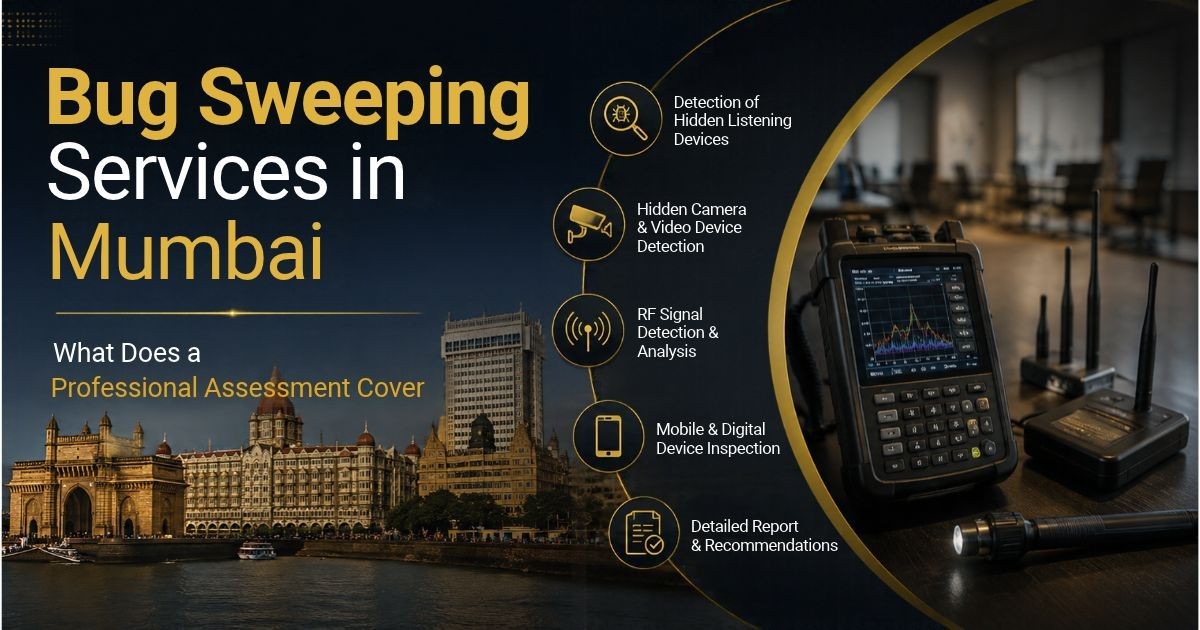
Bug Sweeping Services in Mumbai: What Does a Professional Assessment Cover?
Explore how professional bug sweeping services in Mumbai use physical inspections, RF analysis, and appropriate TSCM methods to assess potential surveillance indicators in homes, offices, and vehicles.

Concerns about hidden cameras, listening devices, or unauthorized electronic monitoring can raise important questions for businesses and individuals. In offices, homes, vehicles, and meeting rooms, it is always possible to determine whether a suspicious object or unusual electronic signal represents a genuine concern through a visual assessment alone.
Professional bug sweeping services in Mumbai involve a structured assessment of the environment, combining physical inspection withappropriate technical methods to examine potential indicators of electronics surveillance. Commonly associated with Technical Surveillance Counter-Measures (TSCM), this process focuses on evaluating specific concerns, identifying relevant anomalies, and documenting findings within the agreed inspection scope.
Understanding what a professional assessment covers can helpindividuals and organizations make informed decisions about their privacyconcerns.
What Are Bug Sweeping Services?
Bug sweeping, also known as debugging or a TSCM assessment, is a systematic inspection intended to identify potential electronics surveillance devices and related technical indicators within a defined environment.
Depending on the location and assessment requirements, the inspection may consider:
- Hidden cameras and concealed recording equipment
- Potential listening devices or unauthorized microphones
- Wireless transmitters and unusual radio-frequency activity
- Possible GPS tracking devices associated with vehicles
- Suspicious electronic components or signs of tampering
- Relevant wiring, fixtures, and connected equipment
The exact scope depends on the environment, the nature ofthe concern and the methods appropriate to the assignment. A professional sweepshould not rely on a single instrument or assume that every unusual object orsignal indicates surveillance.
What Does a Professional Bug Sweep Include?
A well-planned assessment typically involves several stages. Each stage contributes different information and helps specialists evaluate the environment more systematically.
1. Initial Consultation and Scope Assessment
The process generally begins with a discussion of the concerns, the location to be inspected, and the areas requiring attention. A business may be concerned about sensitive information appearing outsideauthorized discussions, while a resident may have questions about an unfamiliardevice or an unexplained change to a private space.
During the initial assessment, the service provider canestablish:
- Whether the inspection concerns an office, residence, vehicle, or meeting space
- Which rooms, fixtures, or equipment should be included
- Whether there are specific objects or locations of concern
- Which inspection methods may be appropriate
- What findings and documentation the client requires
This step helps define a practical inspection plan instead of applying the same procedure to every location.
2. Detailed Physical Inspection
Physical inspection is an important part of professionalTSCM services. Specialists examine relevant areas for unfamiliar devices, unusual installations, signs of interference, or objects that do not appear consistent with their intended purpose.
Depending on the environment, this may include selectedfurniture, electrical fixtures, access panels, communication equipment, roomfittings and other accessible areas within the agreed scope.
In a corporate setting, the inspection may focus on boardrooms, executive offices, and spaces used for sensitive discussions. In a residence, the focus may be on specific rooms or objects associated with the reported concern. Vehicle inspections may include relevant interior areas and accessible locations where unauthorized equipment could potentially be installed.
However, an unfamiliar object is not automatically a surveillance device. Before drawing conclusions, the purpose and characteristics of the object must be assessed.
3. Radio-Frequency (RF) Analysis
RF analysis is another important component of many professional bug sweeps, as it helps identify signals that require further investigation. Specialized equipment, including spectrum analyzers and suitable RF detection instruments, can help examine radio-frequency activity within a specified environment.
This analysis may help identify signals that need further investigation. Specialists consider characteristics such as frequency, signalstrength, patterns of activity, and the surrounding electronic environment.
The interpretation is important because Mumbai offices, residential buildings, and commercial spaces contain many legitimate sources of radio-frequency activity, including Wi-Fi routers, mobile phones, Bluetooth devices, and other wireless equipment.
An RF signal alone does not prove that a surveillance device is present. Potentially relevant signals need to be evaluated incontext, and further examination may be necessary to establish whether an identifiable source presents a genuine concern.
4. Additional Technical Detection Methods
RF scanning is not suitable for identifying every possible device. Some equipment may record information locally without continuously transmitting it, while other devices may operate intermittently or use methods that require a different inspection approach.
Depending on the circumstances, a professional TSCM assessment may use additional tools and techniques, including:
- Non-linear junction detection (NLJD): May help identify electronic components concealed within materials, subject to the instrument's capabilities and the surrounding environment.
- Optical inspection methods: May help examine suspicious openings, lenses, or objects where hidden-camera concerns have been raised.
- Thermal imaging: Can provide information about heat patterns that may warrant further investigation, although heat alone cannot establish the presence of a surveillance device.
- Targeted equipment and wiring checks: May help evaluate accessible electronic systems or connections where the scope and technical circumstances justify further examination.
Not every assessment requires every instrument. The selection of tools should reflect the environment, the suspected device types, and the limitations of the available methods.
5. Assessment of Offices, Homes, Vehicles, and Meeting Rooms
Different environments present different challenges. Professional TSCM Services in Mumbai should be planned around the location rather than treated as a standard checklist that fits everyassignment.
Corporate Offices and Boardrooms
Businesses may request an assessment before importantnegotiations, management meetings, commercial discussions, or other sensitiveengagements. Relevant areas can include meeting rooms, executive offices, and selected communication or presentation equipment.
The assessment may consider physical anomalies andelectronic indicators that warrant further investigation. The scope should beagreed in advance to minimize disruption to routine operations.
Residential Properties
A home assessment may focus on rooms, fixtures or electronicobjects associated with a specific concern. A structured inspection can helpevaluate those concerns without assuming that an unfamiliar device or ordinaryelectronic activity represents unauthorized monitoring.
Vehicles
Vehicle assessments may involve checking relevant accessible areas for potential tracking devices or unauthorized electronic equipment. Because modern vehicles contain many legitimate electronic systems, suspiciousfindings require careful evaluation rather than assumptions based on appearance alone.
Meeting and Conference Spaces
Meeting spaces can contain wireless presentation systems, microphones, speakers, network equipment, and other devices that generate normalelectronic activity. A professional assessment takes these factors into account while examining the areas relevant to the assignment.
6. Evaluation of Findings and Technical Observations
The purpose of a professional sweep is not simply to produce a list of unusual objects or electronic signals. Findings need to beinterpreted in relation to the inspection scope and the available evidence.
Depending on the assignment, observations may be categorized as routine activity, an anomaly requiring additional examination, or a finding that warrants further technical investigation.
If a suspected device or relevant indicator is identified, the next step should be based on the circumstances. This may involve furtherexamination, appropriate documentation, or advice on handling the item. Where potential evidence may be relevant to a legal or investigative matter, anyhandling should take account of applicable procedures and evidence-preservation requirements.
If no suspicious device is identified during the inspection, that result should also be reported accurately. It describes the areas examined and the findings available at the time; it should not be presented as an absolute guarantee that no surveillance method exists anywhere in the environment.
7. Reporting and Recommended Next Steps
A useful TSCM report helps the client understand what wasexamined, what was observed, and whether any further action is recommended.
Depending on the agreed service, documentation may include:
- The locations and areas covered
- The inspection methods used
- Relevant technical observations and findings
- Limitations affecting the assessment
- Areas that may require additional examination
- Practical recommendations for follow-up
Clear reporting is particularly important for organizationsthat need to brief management, review workplace procedures, or maintain records of a technical assessment.
Why Professional Bug Sweeping Matters
Consumer detection gadgets and informal visual checks can beuseful for limited purposes, but they may not provide the context needed toassess a complex environment. Different devices operate in different ways, andordinary electronic activity can produce misleading indications.
A professional assessment brings together inspection planning, physical examination, suitable technical equipment and informedinterpretation. It also recognizes that detection methods have limitations andthat findings must be considered within the defined scope.
For businesses, this approach can support more informeddecisions about sensitive meeting spaces and potential information-leak concerns. For individuals, it can provide a structured way to evaluate a specific concern without relying solely on guesswork.
How to Choose Bug Sweeping Services in Mumbai
Before arranging a TSCM assessment, consider asking the service provider a few practical questions:
- What will the inspection cover? Confirm the locations, equipment, and areas included in the agreed scope.
- Which methods may be used? Ask how physical inspection and technical detection will be selected for your circumstances.
- How will findings be interpreted? A responsible provider should distinguish confirmed observations from signals or objects that require further investigation.
- Will a report be provided? Clarify whether the assignment includes written findings, limitations, and recommendations.
- How will sensitive information be handled? Discuss access arrangements, communication, and the handling of any potentially relevant evidence.
- What are the service limitations? Understand what the assessment can evaluate and what may require a separate examination.
Clear answers to these questions can help you select a service that matches your actual requirements.
Frequently Asked Questions
What is included in professional bug sweeping services inMumbai?
Depending on the agreed scope, an assessment may include a consultation, physical inspection, RF analysis, additional technical detection methods where appropriate, evaluation of observations, and a report withrecommendations.
Can RF analysis detect every hidden camera or listening device?
No. RF analysis is primarily useful for examiningradio-frequency activity. A device that records locally, transmits intermittently, or operates in a different way may require other inspection techniques.
Does an unusual RF signal mean that a room is bugged?
No. Common wireless devices can generate RF activity. A signal must be interpreted in context, and further examination is needed beforeattributing it to a surveillance device.
Are residential and corporate bug sweeps different?
The underlying principles may overlap, but the scope and priorities of residential and corporate bug sweeps differ. Corporate assessments may focus on boardrooms and executive spaces, while residential inspections may address specific rooms or objects of concern.
Does a clean inspection guarantee that no surveilled device is present?
No professional inspection should be represented as an absolute guarantee. The findings apply to the areas examined, the methods used, and the conditions at the time of assessment.
Arrange a Professional TSCM Assessment inMumbai
When concerns about possible electronic monitoring arise, a structured technical assessment can help replace assumptions with documentedobservations. Physical inspection, RF analysis, and other appropriate methods each serve a different purpose, and their value depends on how carefully they are selected and interpreted.
Trace Point India provides services related to TSCM, debugging, and electronic surveillance detection. If you have concerns involving office, residence, vehicle, or meeting space, discuss the circumstances withthe team to determine whether a professional assessment is appropriate.











Facebook Conversations