
When Should Businesses Schedule a TSCM Inspection in Faridabad?
Learn when businesses in Faridabad should consider TSCM inspections for boardrooms, executive offices, confidential meetings, and surveillance risk assessment.

Businesses regularly handle sensitive information, including confidential client discussions, commercial strategies, financial records, intellectualproperty, and executive communications. In environments where information confidentiality is important, assessing potential electronic surveillance risks can be an important part of a broader risk-management strategy.
Technical Surveillance Countermeasures (TSCM) inspections are designed to assess potential indicators of unauthorized electronic surveillance through appropriate physical inspections, electronic analysis, and specialized detection equipment. For organisations in Faridabad, a professionally scoped TSCM assessment may be worth considering when circumstances, operational changes, or specific concerns warrant closer examination.
But when should a business schedule an inspection, and how can it determine whether one is appropriate?
What Is a TSCM Inspection?
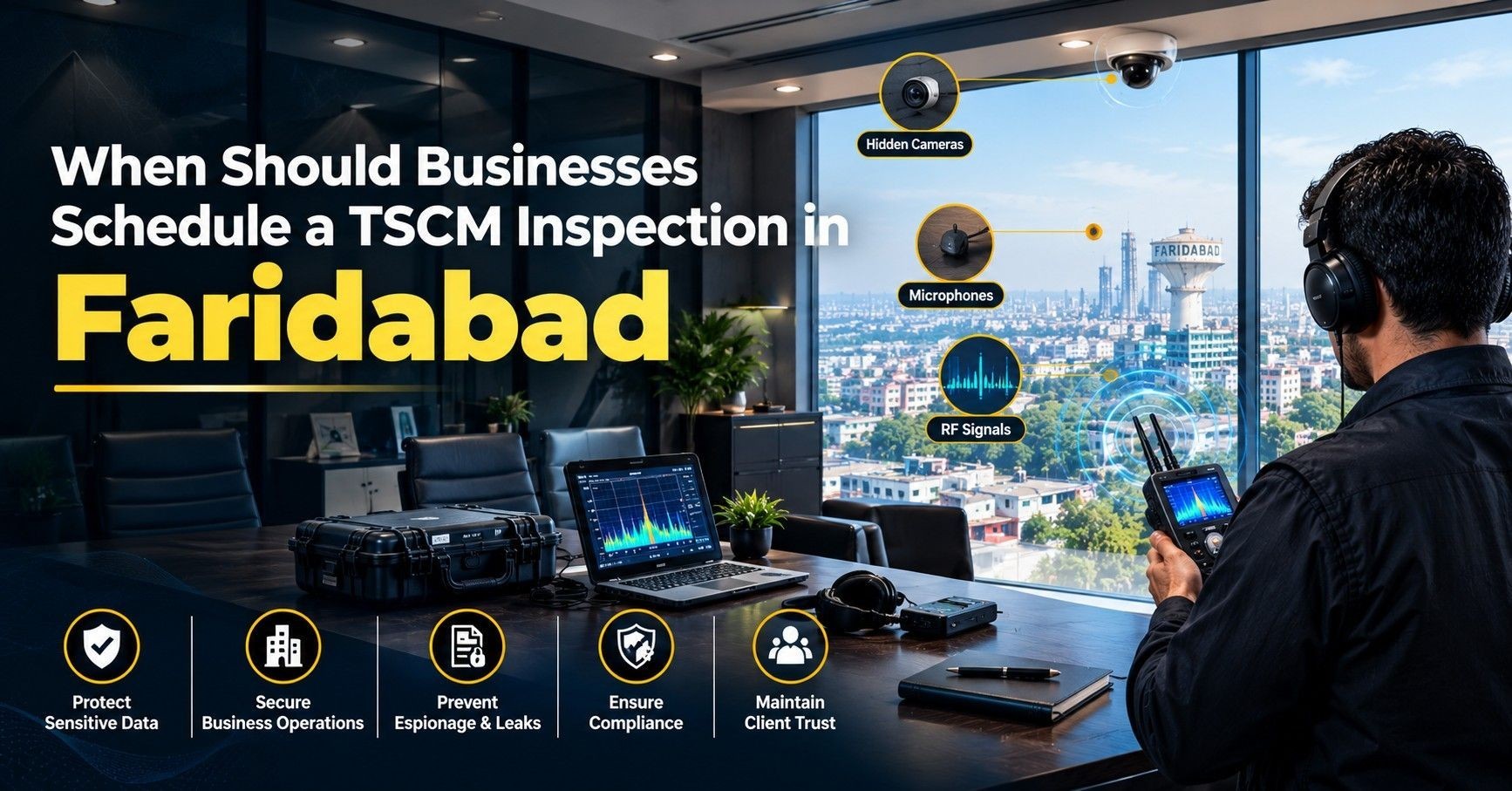
TSCM stands for Technical Surveillance Countermeasures. It refers to a specialized process used to assess environments for potential indicators of unauthorized surveillance devices or activity.
Depending on the assignment, a TSCM inspection may involve a physical examination of selected areas, radio-frequency (RF) analysis, and the use of suitable technical equipment. The scope depends on the premises, the concerns being assessed, and the nature of the potential risks.
Businesses may consider corporate TSCM inspection in Faridabad for executiveoffices, boardrooms, meeting rooms, research facilities, or other locations where sensitive discussions take place.
A TSCM inspection is not a guarantee that every possible surveillance device will be found. The results depend on factors such as the environment, device characteristics, inspection conditions, and the methods used. It also does not replace cybersecurity assessments, access controls, or other information-security measures.
7 Situations When Businesses Should Consider a TSCM Inspection
1. Before High-Stakes Business Negotiations
Merger discussions, acquisitions, contract negotiations, investment meetings, and strategic partnerships can involve commercially sensitiveinformation. Unauthorized disclosure of such information could affectnegotiations, competitive positioning, or business relationships.
When a company is preparing for particularly sensitive discussions, it mayconsider a technical assessment of the designated meeting environment as oneelement of its risk-management process.
An appropriately scoped inspection can help assess potential electronics surveillance indicators before important meetings take place. Businesses shouldalso review who can access the meeting space, how documents are handled, andwhether confidential discussions are conducted in suitable locations.
2. When Confidential Information May Have Been Disclosed Unexpectedly
If details from restricted meetings repeatedly appear to reach people whowere not authorized to receive them, management may need to examine how the information could have been disclosed.
However, unexpected information leaks do not automatically indicateelectronic surveillance. Possible explanations include excessive accesspermissions, accidental disclosure, insecure communications, shared documents, insider misconduct, or ordinary operational errors.
A structured response may involve reviewing access logs, checkingdocument-sharing permissions, assessing cybersecurity controls, and evaluating whether a technical inspection is justified by the available facts.
Professional technical surveillance detection can be considered wherespecific circumstances indicate that an assessment of the physical environment may be useful.
3. After Renovations, Relocation, or Changes to Office Access
Office renovations, changes in tenancy, maintenance work, and the introduction of new contractors can alter the physical environment and the number of people with access to sensitive spaces.
These changes do not establish that surveillance is taking place. Nevertheless, organisations with high confidentiality requirements may choose to review their physical security arrangements after significant changes.
A technical assessment may be appropriate for selected executive offices, boardrooms, or other sensitive areas, depending on the company's risk profile and the circumstances surrounding the change.
This can also be an opportunity to review visitor procedures, accesspermissions, equipment inventories, and controls for meeting rooms.
Read more: TSCM Bug Sweeping in Mumbai: A Professional Guide to Electronic Surveillance Detection
4. When Executive Offices or Boardrooms Handle Sensitive Discussions
Executive offices and boardrooms may be used for discussions involvingcorporate strategy, personnel decisions, legal matters, financial planning, andconfidential commercial information.
Because of the sensitivity of these conversations, some organizations include periodic technical assessments in their broader physical security procedures.
An executive office inspection can be scoped around the rooms andactivities that present the greatest confidentiality requirements. The inspection plan should identify the relevant spaces, define the assessmentobjectives, and establish how findings will be documented.
For businesses that regularly conduct confidential negotiations orleadership meetings, this approach can help integrate technical assessments into an established risk-management program.
5. When There Are Specific, Credible Indicators of Potential Surveillance
A business may receive a credible report, identify an unexplained device that requires examination, or encounter circumstances that reasonably justify further assessment.
In such situations, it is important to document the concern without making assumptions. Unfamiliar electronics, unexplained sounds, or unusual RFsignals may have ordinary explanations and should not automatically be treated as evidence of surveillance.
A qualified professional can help determine whether a technical inspection is appropriate and what methods are suitable for the environment.
If a potentially suspicious device is found, do not dismantle or interfere with it unnecessarily. Depending on the circumstances, preserving the scene and seeking appropriate professional or legal guidance may be advisable.
6. When Research, Product Development, or Intellectual Property Is atStake
Businesses involved in product development, engineering, research, proprietary processes, or confidential design work may have legitimate reasons to assess risks to sensitive information.
Technical inspections can be considered for selected research rooms, executive meeting areas, or other locations where restricted discussions occur. However, physical surveillance risks are only one part of intellectual property protection.
Companies should also evaluate network security, endpoint protection, identity and access management, data-loss prevention, employee accesspermissions, and information-sharing practices.
A balanced approach recognizes that information can be exposed through physical, digital, procedural, or human factors.
7. As Part of a Periodic Risk-Management Program
Some businesses prefer to assess potential risks proactively rather than wait for a specific concern to arise. Depending on their operations, risk exposure, and confidentiality requirements, they may schedule technical assessments at planned intervals or before particularly sensitive activities.
There is no universal inspection frequency that suits every organization. The schedule should be based on the sensitivity of the information handled, the nature of the premises, changes in access or operations, previous findings, andthe organisation's wider security policies.
Periodic business bug sweeping should therefore be treated as a risk-based activity rather than an automatic guarantee of security.
How to Define the Scope of a Corporate TSCM Inspection
Before arranging an inspection, businesses should establish clearobjectives. A defined scope helps the provider understand the environment andenables management to evaluate the results against the original requirements.
Consider the following steps:
1. Identify sensitive areas. Determine whether the assessment should cover executive offices, boardrooms, conference rooms, research spaces, orother selected premises.
2. Explain the reason for the assessment. Describe any specificconcern, recent change, upcoming confidential meeting, or broaderrisk-management objective relevant to the assignment.
3. Agree on suitable inspection methods. The provider should explain which physical and technical assessment methods are appropriate for the environment and what limitations may apply.
4. Coordinate access and scheduling. Establish who will authorize access, which areas are included, and how the inspection can be conducted withminimal disruption to business operations.
5. Confirm reporting arrangements. Ask what the final report willdocument, how observations will be communicated, and whether recommendations for further assessment or remediation may be included.
6. Clarify costs and responsibilities. Confirm the scope, fees, estimated duration, access requirements, and any additional expenses beforework begins.
A clearly defined assignment makes it easier to distinguish the inspection's objectives from assumptions about what it will uncover.
What Can Corporate Debugging Services Include?
Professional corporate debugging services may be designed to assesspotential electronic surveillance risks in selected business environments. Depending on the provider's capabilities and the agreed scope, an assessment may include:
· Physical examination of relevant rooms andaccessible fixtures
· RF analysis to assess relevant radio-frequency activity
· Use of specialized equipment suited to the inspection objectives
· Evaluation of observations that require furthertechnical examination
· Documentation of relevant findings andidentified limitations
· Recommendations for appropriate follow-up measures, where warranted
The precise methods used should reflect the environment and the nature ofthe assessment. Ordinary wireless networks, mobile devices, and otherlegitimate electronics can produce signals that require careful interpretation. RF activity alone does not prove the presence of a surveillance device.
Businesses should look for a provider that explains its methods clearly, reports findings responsibly, and avoids promising guaranteed detection.
TSCM and Cybersecurity: Why Businesses Need Both
A TSCM inspection and a cybersecurity assessment address differentcategories of risk. Neither should be treated as a substitute for the other.
Security area primary purpose
TSCM inspection: Assess potential indicators of unauthorized electronic surveillance in selected physical environments.
Cybersecurity assessment: Evaluate digital systems, networks, applications, and devices for security weaknesses.
Access control limits entry to sensitive premises, systems, and information.
Information governance: Establish rules for handling, sharing, storing, and retaining confidential information.
Staff awareness helps employees recognize and report security concerns and follow established procedures.
For example, a company that is concerned about a confidential presentation being disclosed may need to review access to meeting rooms, permissions for shared files, device security, and the possibility of physical surveillance. The appropriate combination of measures depends on the evidence and circumstances.
Integrating these activities into a single risk-management framework provides businesses with a more balanced approach to confidentiality.
How to Choose a TSCM Service Provider in Faridabad
When evaluating a provider for corporate TSCM in Faridabad, consider the following:
· Relevant experience: Ask about experienceassessing environments similar to yours, such as offices, boardrooms, orresearch facilities.
· Clear methodology: The provider shouldexplain the proposed inspection process and the limitations of the equipment and techniques used.
· Defined scope: Confirm which areas will be assessed and what the assignment is intended to establish.
· Professional reporting: Ask how findings, observations, and limitations will be documented.
· Confidentiality practices: Discuss howsensitive business information and inspection records will be handled.
· Transparent pricing: Obtain a clear explanation of fees, duration, and any additional costs.
· Realistic expectations: Be cautious ofguarantees that every device will be detected or that any unexplained signal proves surveillance.
The right provider should be able to discuss your concerns professionally, recommend an appropriate scope, and explain what an inspection can and cannot establish.
Frequently Asked Questions
How often should a business schedule a TSCM inspection?
There is no single schedule appropriate for every business. Frequency depends on the sensitivity of the information handled, the organisation's riskassessment, changes to premises or access, and any specific concerns thatarise.
Which business areas may be assessed during a TSCM inspection?
Depending on the agreed scope, an assessment may cover executive offices, boardrooms, conference rooms, research spaces, or other sensitive areas. The provider and business should agree on the areas to be examined before work begins.
Does a TSCM inspection guarantee that no surveillance devices are present?
No. TSCM assessments use appropriate methods and equipment to evaluate potential surveillance indicators, but no inspection can guarantee detection of every possible device under all conditions. Findings should be interpreted in light of the inspection's scope and limitations.
Can TSCM replace a cybersecurity audit?
No. TSCM focuses on potential technical surveillance risks in physical environments, while cybersecurity assessments examine digital systems and controls. Organisations may need both, along with appropriate access management and information-handling procedures.
How can a business arrange corporate bug sweeping in Faridabad?
Start by identifying the areas of concern, the reason for the assessment, and the information that requires particular protection. Discuss these detailswith a professional provider to determine a suitable inspection scope, estimated timeline, and cost.
Schedule a Corporate TSCM Assessment in Faridabad
Confidential business discussions, sensitive commercial information, and intellectual property require a risk-management approach that reflects their importance. Depending on an organization's circumstances, a professionally scoped TSCM inspection may form part of that approach alongside cybersecurity, physical access controls, and sound information-handling practices.
Check also for further information on detective services in Delhi to understand the available investigation options for personal and professional matters.
For organisations considering corporate debugging services in Faridabad, the first step is to identify the concern, define the areas requiring assessment, and understand the methods and limitations of the proposed inspection.
Your team can discuss your requirements and the most important needs with us at 9999335950. The team can discuss your requirements and suitable assessment options.













Facebook Conversations