
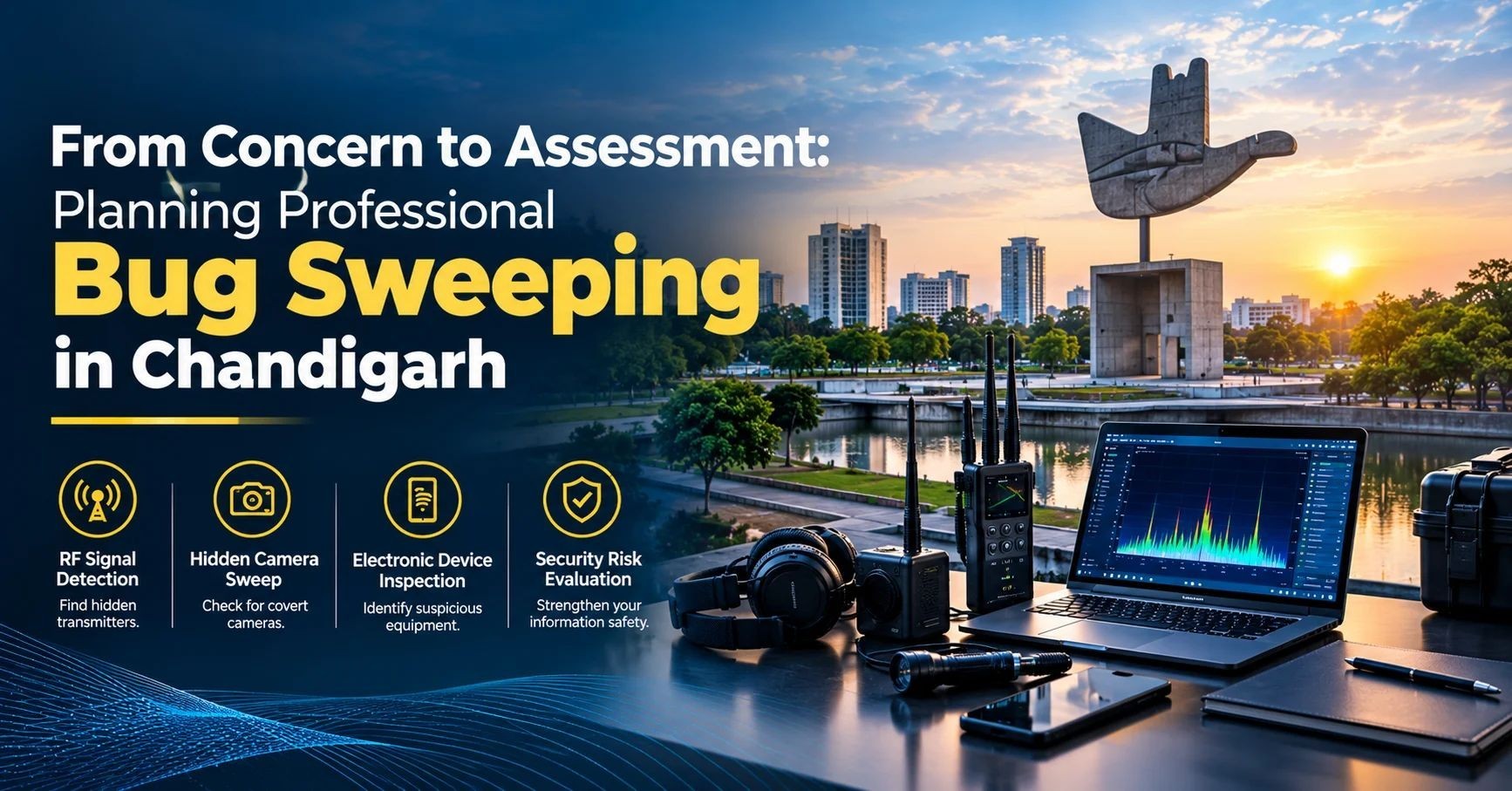
From Concern to Assessment: Planning Professional Bug Sweeping in Chandigarh
Explore how to prepare for a professional TSCM inspection in Chandigarh, choose the right assessment scope, evaluate technical methods, and understand inspection results and constraints.

Concerns about possible hidden cameras, listening devices, or unauthorized electronic monitoring can raise important questions for individuals, business owners, and organizations. However, an unusual object, unexplained electronic activity, or consumer detector alert does not automatically indicate that surveillance is taking place. Understanding the situation and identifying an appropriate course of action are essential first steps.
Professional bug sweeping provides a structured way to assess specific technical surveillance concerns. A Technical Surveillance Countermeasures (TSCM) assessment can help clients understand what has been examined and what conclusions the available evidence supports by using a clearly defined inspection scope, appropriate technical methods, relevant physical examinations, and careful evaluation of findings.
For those considering professional bug sweeping in Chandigarh, preparation helps make the process more focused, practical, and useful. Knowing what to discuss before booking an inspection also helps establish realistic expectations about the methods, documentation, and limitations involved.
1. Start by Identifying the Specific Concern
Before arranging a professional inspection, identify what has prompted the concern. A clear description helps determine whether a technical assessment is appropriate and which areas or methods are relevant.
For example, a business owner may want an office or boardroom assessed before sensitive commercial discussions. An individual may have a specific concern about a residential room or vehicle. An organization may require a technical inspection as part of a wider risk-management process.
Consider the following questions:
- Which location or environment is involved?
- What specific observation or event prompted the concern?
- Is the issue related to a room, vehicle, electronic equipment, or another defined area?
- Are there particular dates, incidents, or observations that may help establish the inspection scope?
- What information or documentation would be useful after the assessment?
Keep the description factual and distinguish direct observations from assumptions. This helps the inspection provider understand the concern without treating an unverified suspicion as an established finding.
2. Decide Which Areas Need Inspection
The scope of a TSCM inspection should reflect the environment and the concern being assessed. A residential property, corporate office, conference room, and vehicle have different physical layouts, electronic systems, access requirements, and inspection considerations.
Corporate offices and boardrooms
Businesses may consider an inspection when they review technical risks around meeting rooms, executive offices, negotiation spaces, or areas where they discuss commercially sensitive information.
The assessment may focus on agreed rooms, accessible fixtures, relevant electronic equipment, and other areas identified during the initial consultation.
Residential properties
For homes and apartments, the scope may include selected rooms, accessible furnishings, fixtures, and relevant electronic equipment. The inspection should be planned around the actual concern rather than assuming that every room requires the same level of examination.
Vehicles
Vehicle-focused assessments require a different approach because of their compact layout, integrated electronics, and restricted access to some components. The inspection scope should specify the vehicle involved and the areas that can reasonably be examined.
Hotels and temporary accommodation
When a concern arises in a hotel room or serviced apartment, the first step is to describe the specific observation and consider appropriate immediate action. A professional inspection may be relevant when there is a credible, defined concern that requires technical evaluation.
In every setting, agreeing on the inspection areas in advance helps establish what is included and what remains outside the assignment.
3. Understand the Role of Professional TSCM Methods
Technical Surveillance Countermeasures is a specialist field concerned with assessing potential technical surveillance risks. Professional bug sweeping may combine several methods, depending on the environment, available access, and the purpose of the inspection.
Physical inspection
A physical inspection may involve examining accessible fixtures, objects, equipment, and other relevant areas for irregularities that warrant further assessment. The significance of an observation must be evaluated in context; an unfamiliar object or modification is not, by itself, proof of surveillance.
RF spectrum analysis
Radio-frequency analysis may help evaluate wireless activity within the relevant environment. Because ordinary devices such as Wi-Fi routers, smartphones, and wireless peripherals can produce RF signals, readings must be interpreted carefully.
An unusual signal does not automatically identify its source or establish that it is associated with unauthorized monitoring.
Appropriate technical instruments
Depending on the assignment, suitable instruments may be used to investigate specific technical concerns. Instrument selection should follow the inspection requirements rather than relying on a single gadget for every situation.
Evaluation of findings
The value of an assessment depends on more than collecting readings. Relevant observations need to be considered alongside the inspection conditions, the capabilities of the instruments used, and the agreed scope.
Not every assignment requires every method. A professional provider should explain which techniques are appropriate and why.
4. Prepare the Location Before the Inspection
Practical preparation can help make a professional bug-sweeping assessment more efficient.
Before the scheduled inspection, please consider the following steps:
- Confirm the areas to be examined: Identify the rooms, workspace, vehicle, or equipment included in the agreed scope.
- Arrange access: Ensure that authorized personnel can provide access to the relevant areas and equipment.
- Discuss operational requirements: Explain any business activities, appointments, or environmental conditions that could affect scheduling.
- Identify relevant equipment: Tell the provider about electronic systems or other site-specific considerations that may influence the inspection.
- Clarify responsibilities: Establish who will coordinate access, answer questions, and receive the findings.
- Discuss documentation needs: If the inspection is for an organization, clarify whether a written report or other record is expected.
Avoid unnecessary dismantling or alterations before the inspection unless directed by an appropriate professional. If a particular object or incident has prompted concern, describe it to the provider and ask how it should be handled.
Preparation should support the assessment without creating the impression that every unusual feature is evidence of a problem.
5. Ask the Right Questions Before Booking
Choosing a professional bug-sweeping provider involves understanding the proposed process, not simply comparing equipment lists or promotional claims.
Before confirming an assignment, ask:
What is included in the inspection?
Request a clear description of the locations, equipment, and areas covered. Confirm whether the assignment includes physical inspection, technical measurements, or other relevant methods.
Which methods are appropriate for my concern?
The provider should be able to explain the proposed approach in understandable terms and describe why the methods fit the environment.
What access will be required?
Some areas or equipment may require authorization, specialist access, or additional arrangements. Clarify these requirements before the inspection begins.
Will I receive documentation?
Ask whether the assignment includes a written report, what it is expected to cover, and how observations, findings, and limitations will be distinguished.
What are the limitations?
No inspection should be represented as a guarantee that every possible surveillance device will be found. The provider should explain how access, operating conditions, equipment capabilities, and the defined scope may affect the assessment.
How will sensitive information be handled?
For corporate and personal assignments, discuss confidentiality expectations, information handling, and who will be authorized to receive the results.
Clear answers help clients make an informed decision and establish reasonable expectations before work begins.
6. What Should You Expect During a Professional Bug Sweep?
The precise process varies by assignment, but a structured assessment generally begins with confirming the scope and understanding the environment.
The provider may then carry out the agreed physical and technical checks, document relevant observations, and evaluate findings in the context of the methods used.
Where an observation warrants additional examination, the provider should explain why further assessment may be appropriate. A reading or irregularity should not be presented as definitive proof without adequate supporting evidence.
The final discussion should address the work completed, the findings that can reasonably be reported, and any recommended next steps.
Clients should also understand that inaccessible areas, equipment that is not operating or transmitting during the inspection, environmental interference, and other technical factors can affect what an assessment establishes.
7. Understanding the Inspection Report and Its Limitations
Documentation is an important part of a professional TSC assessment, particularly for organizations that need a record of the work performed.
Depending on the assignment, a report may include:
- The purpose and agreed scope of the inspection.
- The areas or equipment examined.
- The methods and instruments used, where relevant.
- Significant observations and technical findings.
- Limitations, access restrictions, or factors affecting interpretation.
- Recommendations for further evaluation or appropriate follow-up.
A report should distinguish between an observation, an technical finding, and a conclusion. These are not necessarily interchangeable.
For example, detecting RF activity does not automatically establish the presence of a hidden listening device. Likewise, the absence of a relevant finding during a particular inspection does not prove that every possible device is absent from the environment.
Responsible reporting explains what the assessment supports, what remains uncertain, and whether any additional steps are justified.
8. When Is Professional Bug Sweeping Worth Considering?
A professional assessment may be appropriate when a specific concern cannot be adequately evaluated through ordinary checks or when an organization needs a documented technical review.
Situations may include:
- Preparing a boardroom or meeting space for sensitive business discussions.
- Assessing a defined concern involving a residential property.
- Reviewing a vehicle after a specific, credible observation.
- Investigating unexplained technical indicators that require contextual evaluation.
- Establishing a documented baseline for a particular environment.
- Reviewing inspection requirements as part of a corporate risk-management process.
The decision should be proportionate to the circumstances. Consumer detectors and visual checks may provide preliminary observations, but they cannot replace a professional assessment in every situation.
Equally, professional bug sweeping should not be treated as unnecessary merely because an ordinary electronic signal or unfamiliar object has been noticed. The reason for the inspection, the potential consequences, and the available information should guide the decision.
Professional Bug Sweeping in Chandigarh with Trace Point India
Chandigarh's corporate offices, commercial premises, residences, and executive work environments can present different technical inspection requirements. A suitable assessment starts by understanding the client's concern, defining the relevant areas, and selecting methods appropriate to the assignment.
Trace Point India provides TSCM and professional bug-sweeping services for individuals, businesses, and organizations. Depending on the agreed scope, an assessment may involve physical inspection, appropriate technical instruments, evaluation of relevant observations, and documentation of findings and limitations.
The emphasis is on a structured, technically informed process. The purpose is to assess specific concerns responsibly, not to turn unexplained activity into an unsupported conclusion or promise that every possible device can be detected.
For clients in Chandigarh, discussing the environment and the reason for the inspection before booking can help determine the appropriate scope and clarify what the assessment can reasonably establish.
Frequently Asked Questions
How do I know whether I need professional bug sweeping inChandigarh?
Start by identifying the specific concern, the location involved, and what you need the assessment to establish. If the issue requires a technical examination beyond your own observations, a professional consultation can help determine whether an inspection is appropriate.
How long does a professional TSCM inspection take?
The duration depends on factors such as the size and type of the environment, the number of areas included, the methods required, access conditions, and the agreed scope. Ask the provider for an estimate based on your particular requirements.
Can a professional bug sweep guarantee that no hidden devices are present?
No. Detection depends on the equipment involved, operating conditions, inspection methods, access, and other technical factors. A responsible provider should explain these limitations and avoid absolute guarantees.
Does every TSCM inspection include RF spectrum analysis?
Not necessarily. The methods should be selected according to the concern, environment, and agreed scope. RF analysis may be relevant in somesituations, while physical inspection and other suitable methods may beimportant in others.
Will I receive a report after the inspection?
Reporting arrangements vary by provider and assignment. Confirm in advance whether written documentation is included and whether it will cover the inspection scope, methods, findings, limitations, and recommendations.
Take an Informed Next Step
Planning professional bug sweeping begins at Trace Point India with a clear understanding of the concern, the environment involved, and the outcome you need from the assessment. Defining the scope, discussing suitable methods, arranging access, and understanding reporting limitations can help you make a more informed decision.












Facebook Conversations