
"I'm Not Flexible Enough": What Traditional Rishikesh Masters Want Stiff Beginners to Know
Authentic Rishikesh yoga, taught by experienced teachers and shared with students everywhere, online and on the banks of the Ganges, one mindful breath at a time.

Walk into almost any yoga hall in Rishikesh on the first morning of a new course and you will hear some version of the same confession. "I can't even touch my toes." "My hips are like concrete." "I think I'm the stiffest person here." The teachers have heard it for decades, and their reaction is rarely a pep talk. Usually it is a calm nod, as if the student had just said they were hungry before a meal.
That calm comes from a simple fact: the tradition never measured yoga by how far a body folds. If stiffness is the thing that has kept your mat rolled up in a cupboard, starting with online yoga for beginners is one of the lowest-pressure ways to test that idea for yourself. You practise in your own room, at your own pace, with no row of limber strangers to compare yourself to.
The Two-Word Definition Instagram Left Out
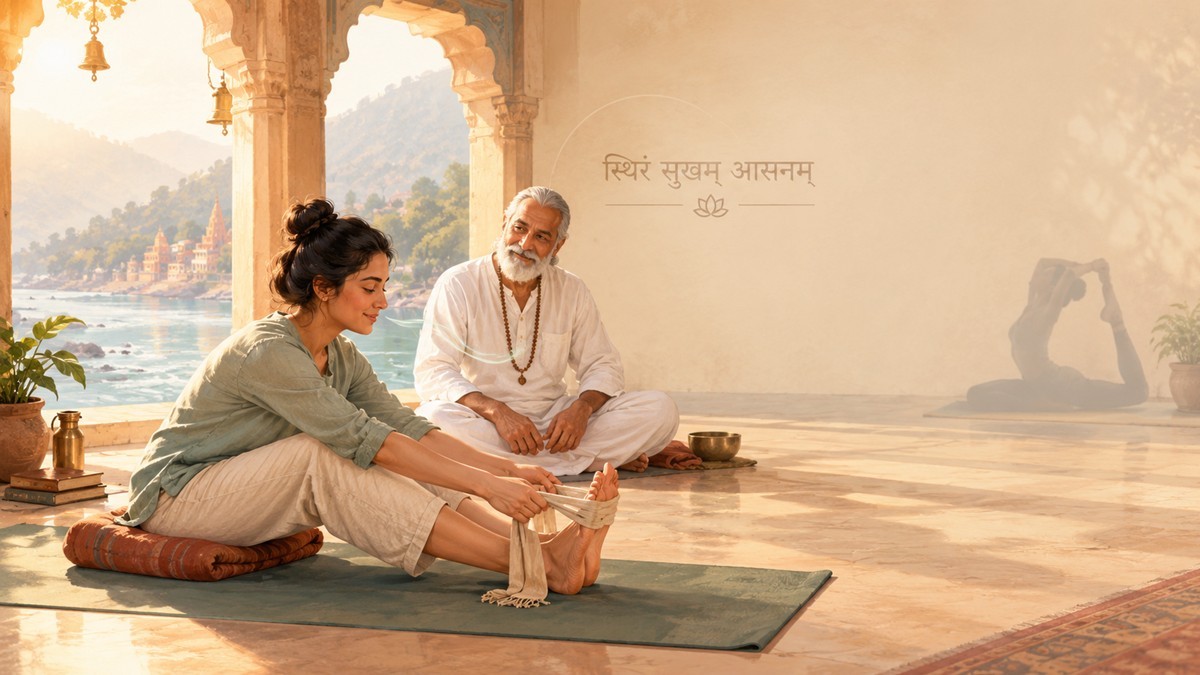
The classical text most teachers lean on, Patanjali's Yoga Sutras, says very little about postures. The line on asana, usually rendered as sthira sukham asanam, describes a posture that is steady and comfortable. That is the whole brief. Nothing in it asks for a split, a deep backbend or a palm flat on the floor.
Masters in the valley tend to return to this line whenever a student apologises for their body. A pose is "working" when you can stay in it with a steady mind and an even breath. A stiff person breathing calmly in a modest forward bend is closer to that definition than a flexible person gripping their way into a showy one.
Your Hamstrings Are Rarely the Whole Story
Most beginners assume tightness is a fixed trait, like height. In practice it is usually a blend of habits: long hours in a chair, little movement variety, and a body that has learned to brace. Muscles that are asked to move through a new range slowly, and repeatedly, tend to respond. Muscles that are forced tend to guard.
This is why traditional teachers spend so much time on breath before they spend any on depth. A long, unhurried exhale is a signal to the body that it is safe to let go a little. Students are often surprised that the sensation of "getting looser" in the first few weeks has more to do with relaxing than with stretching.
Why Teachers Quietly Like Stiff Students
Here is something instructors rarely say out loud: a stiff beginner can be a joy to teach. Very flexible students can slide into shapes without feeling the muscular work underneath, and they sometimes need to be taught restraint. A stiff student feels everything. They notice the exact moment a stretch begins, they cannot cheat their way past it, and they usually listen closely to cues because they need them.
That honesty is a real advantage. It means your attention is already tuned to sensation, which is the skill yoga is actually trying to build.
What a Sensible First Fortnight Looks Like
Forget the idea of "earning" advanced poses. A beginner who is serious about progress, and stiff on top of it, does well with a modest routine:
- Short sessions. Twenty to thirty minutes, most days, beats one punishing hour on Sunday.
- Bent knees, always allowed. In forward folds, softening the knees is not cheating. It protects the lower back and lets you feel the right area.
- Homemade props. A firm cushion under the hips for seated poses, a scarf or belt to extend your reach, a pile of books as a block. Props are standard equipment in traditional classes, not a sign of weakness.
- Breath before range. Spend the first minutes of each session simply lengthening the exhale.
- Rest at the end. Finishing with a few minutes lying still lets the practice settle, and it makes you want to come back tomorrow.
If you have a past injury, are pregnant, or manage a health condition, check with a doctor before beginning, and tell your teacher at the start of class.
Sentences Worth Retiring
Some phrases do more damage than a tight pair of hips. "I'll start once I'm more flexible" is the classic, and it is circular, because the practice is what creates the change. "Everyone else here is better than me" is another. Nobody in a well-run beginner class is watching your forward fold; they are busy wondering about their own. And "I'm too old / too heavy / too stiff" ignores that the people who turn up in Rishikesh ashrams range widely in age, build and ability, and the teachers adapt to all of them.
Swapping those for something kinder, such as "I'm starting where I am," sounds like a small thing. It tends to be the decision that actually keeps people on the mat.
Picking a Class That Won't Rush You
The format matters more than the brand name on the screen. When you are new and tight, look for these signs:
- Live or well-paced guidance. You should hear the teacher say what to do, why, and how to make it easier.
- Modifications offered as normal. If every cue assumes the deepest version of a pose, the class is not built for you.
- A foundation-first structure. Basic alignment, breathing and simple sequences should come before anything acrobatic.
- Roots in the tradition. Teachers who trained in places like Rishikesh usually bring the unhurried, inward-looking approach described above rather than a fitness-first one.
Schools such as Ganga Yogshala run foundational online batches along these lines, so a student in Jaipur, Toronto or Berlin can start with the same basics people learn on the banks of the Ganges, without booking a flight first.
The Toe-Touch Can Wait
Somewhere around the third or fourth week, many stiff beginners notice something odd. They have barely changed their reach, yet they sleep a little better, sit a little taller, and feel less rushed in their own skin. The toes are still a few inches away. It stops mattering.
That is what the old masters were quietly hinting at when they smiled at the nervous confession on day one. The body you have today is a perfectly good place to begin. Unroll the mat, bend your knees, and breathe out slowly.













Facebook Conversations